
 Image 1 of 1
About the author
Isaac Bashevis Singer (1903–1991) was awarded the Nobel Prize for Literature in 1978. An immigrant from Poland, he arrived in New York following the steps of his older brother, Israel Joshua Singer. He wrote essays, stories, and other writings for the Forverts, at times under pseudonym. For years Singer published his stories in The New Yorker, where he developed a distinct style. His work has been translated into dozens of languages.
About the translators
Saul Bellow (1915 - 2005) was born of Russian Jewish parents in Lachine, Quebec, and was raised in Chicago. He received his bachelor’s degree from Northwestern University in 1937. His novel The Adventures of Augie March won the National Book Award for fiction in 1954. His further awards include the Pulitzer Prize for Humboldt’s Gift (1975); the International Literary Prize for Herzog, for which he became the first American recipient; and the Croix de Chevalier des Arts et Lettres, the highest literary distinction awarded by France to non-citizens. In 1976, Bellow was awarded the Nobel Prize for Literature.
David Stromberg, a writer, translator, and literary scholar, is editor for the Isaac Bashevis Singer Literary Trust. His books include Baddies, Idiot Love and the Elements of Intimacy, and A Short Inquiry into the End of the World. He is the editor of Old Truths and New Clichés: Essays by Isaac Bashevis Singer (Princeton, 2022).
About the illustrator
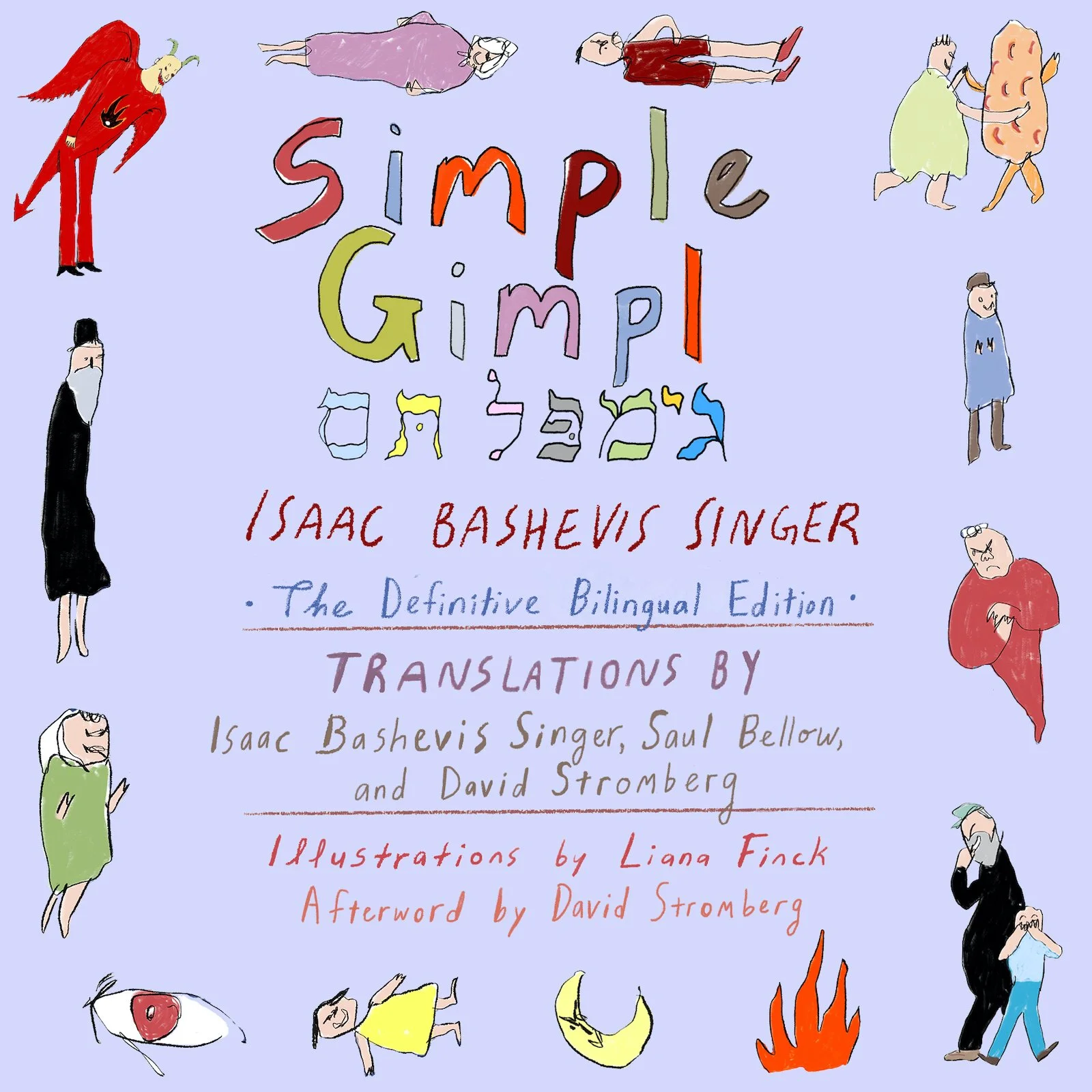
Liana Finck is a regular contributor to The New Yorker, The Awl, and Catapult. She is a recipient of a Fulbright Fellowship, a New York Foundation for the Arts Fellowship, and a Six Points Fellowship for Emerging Jewish Artists. She has had artist residencies with the MacDowell Colony, Yaddo, the Lower Manhattan Cultural Council, and Tablet magazine. Her first book, A Bintel Brief, was published in 2014.
Book Details
ISBN: 9781632060389
eBook ISBN: 9781632060624
Publication date: March 14, 2023
6” x 6” • 96 pages
Other buying options
Amazon | Kindle | Barnes & Noble | Kobo
Praise
“On its own, the story is magnificent: a little jewel cut with a manic humor. But the real value of this volume is in laying the two translations side by side and comparing the different flavor each one lends to Singer's prose…Beautifully printed and presented, this new edition is a gift to readers and scholars alike.”
—Kirkus Reviews, Starred Review
“The narrative in Simple Gimpl is slow-moving, reflective, and witty. It is an undeniable pleasure to read—and certainly not difficult to read multiple times in a row, as this edition of the book incites the reader to do. . . . Over the course of more than one hundred pages, one must realize that this is not a book about Gimpl, and not even about the differences between Saul Bellow’s Gimpel and Isaac Bashevis Singer’s Gimpl. It is about the role of the translator; it is about the strange impossibility of rendering a story.”
—Rachel Landau, Asymptote