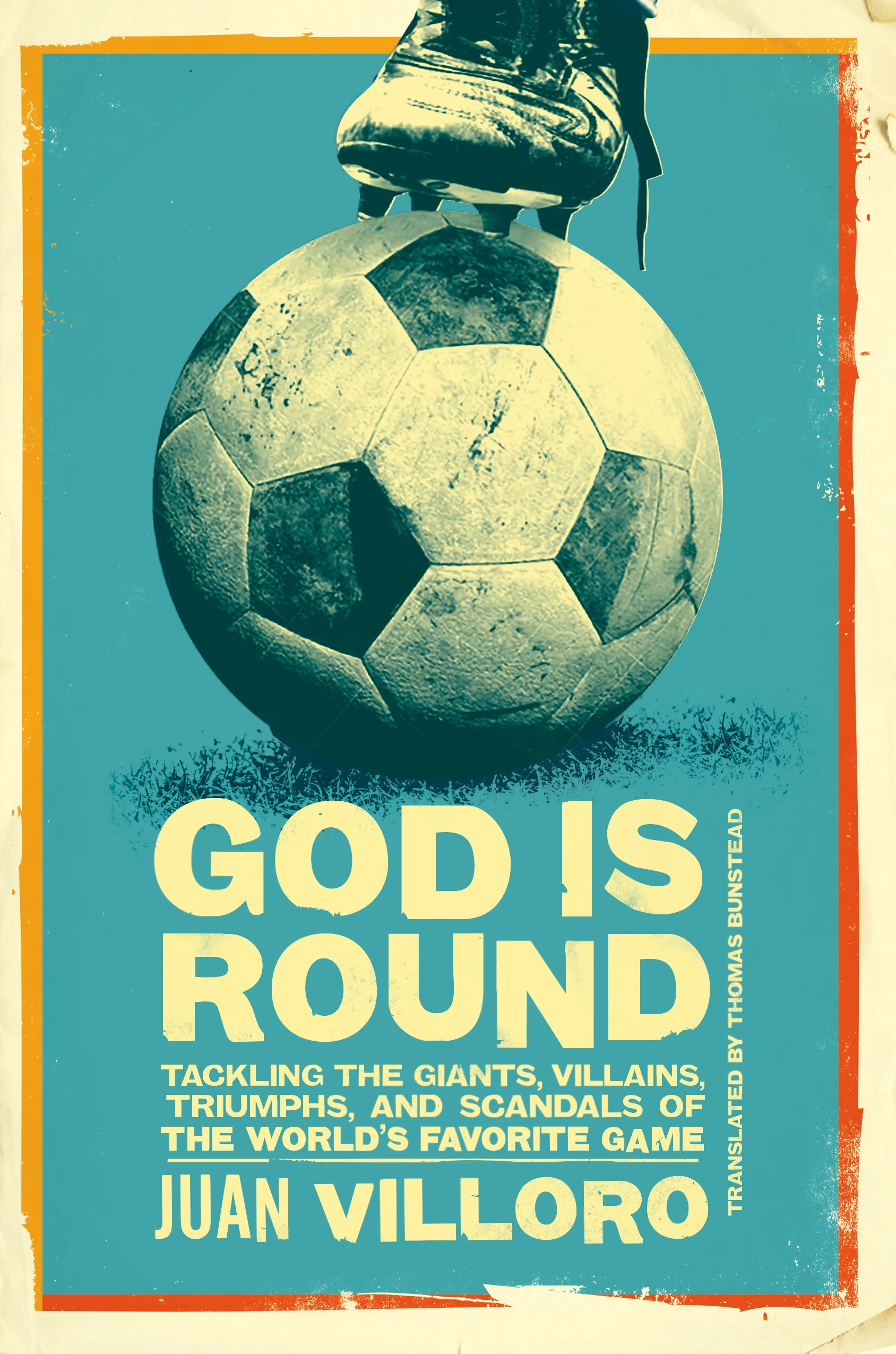
Rave Reviews for God is Round from Around the World
The Spectator: ‘Juan Villoro is the best football writer you've never heard of’
“Latin Americans... tend not to make the distinction between literature and sports writing. Gabriel García Márquez and Mario Vargas Llosa, both Nobel laureates, took to writing about the game early on in their careers. Juan Villoro is one of Mexico’s foremost men of letters. A renowned novelist, short-story writer and translator into Spanish of authors as diverse as Graham Greene, Goethe and Truman Capote, Villoro has shown... his Borgesian range of being as at home with D.H. Lawrence and W.B. Yeats as he is with the Hispanic canon. Unlike Borges, who loathed the game, Villoro is also one of the best writers on football in the world. Early on in this remarkable collection of essays, Villoro sets out his stall as a writer of sport…. God is Round will of course draw comparison with Eduardo Galeano’s paean to the game, Football in Sun and Shadow. Where Galeano hitched the lyrical to hyperbole, Villoro is a far more honest writer and thinker…. In successfully marrying his love of literature and football, Villoro has demonstrated the first principle of sports writing, or any good writing for that matter.”
—Andreas Campomar, The Spectator
The Boston Globe: 'Strange and soulful as the game itself'
"In these lyrical essays about the beautiful game — the one we call soccer and everyone else calls football — Villoro mines the psychological and emotional depths of what the sport represents, and what it means, and feels like, to be a fan. Many of these pieces center on the way sports can evoke a state of childlike wonder, blending our joy of play with our deepest associations with our parents, our neighborhood, our city…. Strange and soulful as the game itself, Villoro’s pieces will send many readers to Wikipedia to check out key plays and legendary players... [The book] captures something ineffable about what it means to love a team and a sport. This makes Villoro’s scathing takedown of soccer’s governing body even more poignant.”
—Kate Tuttle, The Boston Globe
FourFourTwo Magazine Gives God is Round Four Stars
“Mexico’s answer to Bill Bryson, Villoro has spent his life watching football. This collection of essays range from straighter profiles of Diego Maradona and Lionel Messi to touching odes to fandom. His description of Savo Milosevic holding court at the Bernabeu for Osasuna is worth the price of the book alone.”
—FourFourTwo
Bookforum: ‘Only writing as good as Villoro’s can actually accomplish the feat.’
“Villoro manages to bring some of that magic back into relief—to make it strange and new again. There are countless experts who can rattle off Luis Ronaldo’s career stats, but this won’t capture the player’s haphazard and bizarrely successful style anywhere near as well as Villoro’s description…. But God Is Round’s real value lies not in its ideas but in the approach Villoro takes to soccer writing.... By marshaling his imagination and linguistic resources, Villoro is able to resuscitate the rich childhood fascination that originally got us praying to the “weekend god.” This is the goal of most expressions of fandom, but only writing as good as Villoro’s can actually accomplish the feat.”
—Bookforum
Howler Magazine Dummy Podcast: ‘An unbelievably outstanding collection of essays about soccer’
“a fascinating look at the big characters and funny details from the world of soccer.… A literary hero of mine… [He’s in the] top three soccer writers for me…. So good!… an unbelievably outstanding collection of essays about soccer.… Brilliant writer.… It’s like seeing the game with new eyes.”
—George Quraishi, Howler Podcast
NBC News Interview with Juan Villoro
NBC News Latino features Juan Villoro's God Is Round with an interview with the author, whom they call “Mexico's top fútbol expert.” The conversation examines soccer as a kind of religion and soccer teams as models for ideal societies, and connects recent FIFA scandals with the release of the Panama Papers. Villoro also discusses the status of American soccer.
Read the interview on NBC News
Los Angeles Review of Books’ The Eephus: “Timeless”
“Juan Villoro’s God Is Round takes an all-encompassing approach, finding a welcome overlap between writing about soccer as metaphor and writing about soccer for the sake of writing about soccer.… At times the effect of Villoro’s book can feel like the distillation of several decades’ worth of great soccer writing, filtered through a broader literary lens. And that hearkens to a kind of tradition, too: the effect that books as disparate as Nick Hornby’s Fever Pitch and John King’sThe Football Factory have had in drawing people to the sport.… [A] timeless set of observations about the sport.”
—The Eephus, Los Angeles Review of Books
Kirkus Gives God is Round a Starred Review
"A lyrical exploration of the global game of soccer. In the most prosaic sense, Villoro is a Mexican journalist and professor of literature. But when he writes about soccer, these job titles are insufficient. When tackling the beautiful game, the author is a poet and a critic, a philosopher and a historian, a keen observer and a devoted fan.... Villoro brings some memorable line, some delightful turn of phrase, some inescapable image to every page. Readers will be reminded of a similar stylist, Eduardo Galeano, whose Soccer in Sun and Shadow has always represented the literary apogee of writing about soccer.... For millions around the world, soccer is not just a game, but rather life itself and, as Villoro ably reveals, very much worth pursuing to the final whistle.”
—Kirkus (starred review)
International Soccer Network: 'The most anticipated football title of 2016'
“The most anticipated football title of 2016.... [Villoro] is the perfect person for this title.... God Is Round is real literature, not just another book about football. Villoro’s words are like poetry, rich and full of meaning.... God Is Round is certainly on par with David Goldblatt’s The Ball Is Round: A Global History of Soccer and Eduard Galeano’s Soccer in Sun and Shadow, arguably the finest football titles ever written. If you can only purchase one book this year, it has to be God Is Round. Football fans and those that enjoy great literature will be equally enthralled with this one.”
—International Soccer Network
World Literature Today: 'an indispensable companion to international soccer'
“Reading God Is Round will make fans of soccer and good writing alike wonder how they appreciated either before they read Villoro’s insightful, critical, and ultimately hopeful take on the world’s game.... God Is Round is not only an indispensable companion to international soccer but also a fine introduction of US readers to an award-winning Mexican author whose talent and skill demand that more of his work—novels, short stories, essays, and chronicles—be translated into English.”
—World Literature Today
Carlos Fuentes: 'Go talk to Juan Villoro'
“If you want to talk about soccer, go talk to Juan Villoro.”
—Carlos Fuentes
The New York Times: 'one of Mexico’s most decorated and esteemed writers'
“In trying times like these, when the anguish and uncertainty can be almost too much to bear, Mexico turns to him, its philosopher-fanatic, to make sense of the seemingly nonsensical.... Juan Villoro, one of Mexico’s most decorated and esteemed writers — who also happens to be a leading soccer analyst—comes charging down the metaphorical field to scold, explain and extract the lessons within.”
—The New York Times
The New Yorker: 'boyishly effusive, brimming with laughter and cleverness'
“[Villoro] has assumed the Octavio Paz mantle of Mexican public wise man of letters (though with none of Paz’s solemnity, for Villoro is as boyishly effusive, brimming with laughter and cleverness, as Paz was paternalistically dour—and, of course, Villoro, the author of the book God Is Round, may be the most fútbol-obsessed man alive)”
—Francisco Goldman, The New Yorker







Edited by Ilan Stavans
In this rich, eye-opening, and uplifting anthology, dozens of esteemed writers, poets, artists, and translators from more than thirty countries send literary dispatches from life during the pandemic. A portion of proceeds benefit booksellers in need.
World Literature Today’s 75 Notable Translation of 2020
Paperback • ISBN: 9781632063021
Publication date: Aug 25, 2020