
October 2, 2023
Literary Hub is pleased to announce the winner of the Restless Books Prize for New Immigrant Writing, which each year awards $10,000 and publication to a first-time, first-generation immigrant author, alternating yearly between fiction and nonfiction. The 2023 nonfiction prize goes to Catharina Coenen for a collection of essays, Unexploded Ordnance, which will be published by Restless Books in 2025. This year’s prize was judged by Grace Talusan, Jiaming Tang, and Ilan Stavans.
Catharina Coenen is a first-generation German immigrant to Pennsylvania, where she teaches biology at Allegheny College. Her essays have been nominated for the Pushcart Prize and have appeared on the Best American Essays Notable list as well as in literary magazines such as The Threepenny Review, The American Scholar, The Christian Science Monitor, and Best of the Net. Catharina is the recipient of creative nonfiction prizes from the Appalachian Review and from The Forge, a Creative Nonfiction Foundation Science as Story Fellowship, and a Hedgebrook Residency.
About Unexploded Ordnance—the judges’ citation
What happens to the body after trauma? To the bodies of those descended from trauma? What becomes of desire that has been subsumed?
These are the questions that arise from this staggering collection of essays, one that brilliantly examines the legacy and inheritance of trauma in three generations of German women. The hurts and silences, ambitions and dignities of grandmothers, aunts, mothers, and daughters take center-stage, giving voice to a range of experiences that feel both timely and timeless. As Coenen reflects on how she came to her own queer identity, she does not shrink from examining her family’s past, sharing stories that implicate the suffering caused by her grandparents’ Nazi ties as a powerful act against secret-keeping.
Unexploded Ordnance invites the reader to think, perhaps for the first time, about the intersection of science, immigration, choice, and memory. Coenen’s perspective as a biologist informs how she brings the personal and political together, allowing the reader to see as a scientist, but through an artist’s gaze. And yet, beneath the strength of her voice—frank, tender, wise—there is a way in which her expertise disappears into the work itself.
Coenen also challenges our perception of what nonfiction can be. Her approach shows both an urgency and a formal inventiveness. No two essays feel the same, and yet there is a powerful sense of cohesion in the reading experience, as well as a sense of awe—the essays are themselves small grenades thrown against walls of silence, denial, and shame. If it is the duty of the scientist to explore the natural world, Coenen does it beautifully by turning her focus to our most basic makeup: the stories we carry in our genes. We are all beneficiaries of her courage and determination.
—Prize Judges Grace Talusan, Jiaming Tang, and Ilan Stavans
Catharina Coenen on her winning memoir
When I first moved to the U.S. from Germany for graduate school in botany, I was shocked by the ease with which many Americans joked about “Nazis.” Yet I could not explain that the word shook me to the core—claiming space for my emotions or for my family history felt inconceivable in the face of the suffering that my grandparents’ generation had caused.
Ten years ago, I took my first creative nonfiction class. I meant to write about plants, but every piece I wrote twisted itself into stories about my mother’s and grandmother’s experiences during World War II. The linked essays in Unexploded Ordnance examine how fascism, genocide, silence, and the bombs of World War II shaped three generations of women in my Catholic-German family and my life as a queer, first-generation immigrant.
Growing up in a country that started two world wars and was responsible for the Holocaust, I learned about Hitler and the concentration camps in school. But I never questioned why I woke up screaming from nightmares of fires and of trains, or why my teenage friends’ interest in boys struck me as odd. My mother was five at the end of the war. When I was young, she never talked about hiding in basements while bombs shook the walls, or about fleeing burnt-out cities in overcrowded trains, stuffed in the baggage net above her mother’s head. She never mentioned her months in an orphanage, or hiding her mother under the baby’s crib during the mass rapes committed by invading French soldiers across southern Germany. Decades after I moved to America, I fell in love with a woman. Amid the wreckage of my marriage, I remembered the wartime anecdotes my grandmother had dropped into my childhood like small grenades. I began to question my mother about her memories, and to tie them to what I had learned in school. Writing helped me to understand the link between my grandmother’s denial of my aunt’s mental illness and Nazi killings of disabled children in the first gas chambers. I learned how threats to disabled people, gay people, Jewish people, political dissidents, anyone labeled as “different,” had bent my life. Those threats persist, across borders, to this day.
To write and to publish has become my way to fulfill a promise I gave when I first entered the U.S. as a Fulbright student in 1989: to help nations understand each other, so they may live in peace.
Read an excerpt from Unexploded Ordnance in The Common.
Announcing the Finalists for the 2023 Restless Books Prize for New Immigrant Writing in Nonfiction
We are delighted to partner with The Common in announcing the four finalists for the 2023 Restless Books Prize for New Immigrant Writing.
Since its inauguration in 2015, the Restless Books Prize for New Immigrant Writing has supported the voices of writers whose work brings fresh urgency to crossing cultural and linguistic divides, questions our sense of self in an increasingly interdependent world, and lends a voice to what it means to leave one home for another and why these stories need to be told. The winner will receive $10,000 and publication with Restless Books. This year’s judges—Grace Talusan, Jiaming (Andy) Tang, and Ilan Stavans—have selected the following four finalists.

How to be UnMothered by Camille U. Adams
Can abandonment be good luck if a mother turns out to be even worse? Narrated in poetic prose and the rhythmic patois of Trinidad and Tobago, How to be UnMothered reflects upon the multifaceted cruelties of a mother who subjects her daughters to neglect. It journeys from the aquamarine seas and lush greenery of Trinidad and Grenada to England, Canada, and New York City. It explores Caribbean history from pre-colonialism to the present, and questions what the author sees as the chokehold of African spirituality. In the end, it affirms the role of choice in determining multi-generational legacy.
A Broken Russia Inside Me by A. Molotkov
Do we shape circumstances or are we shaped by them? A Broken Russia Inside Me is the story of a writer born into a totalitarian world and a tale of forging an identity outside what was given. At the age of twenty-two, Molotkov makes the decision to emigrate and, with $343 in cash, build a new life in the United States while the Soviet Union collapses and Russia is claimed by increasingly ominous leaders. He investigates what it means to be from a place he’s ashamed of and seeks to eradicate from within himself while also exploring how his choices and relationships still influence his attitudes and social responsibilities.
Unexploded Ordnance by Catharina Coenen
A collection of essays that interrogates what it means to come from a place where horror originates, and how terror can shape lives across generations, sometimes through our very DNA. Coenen, a doctor of biology, grew up in Germany and immigrated to the United States as an adult. Her mother, who had been five at the end of WWII, never talked about sheltering in basements while bombs shook the walls, fleeing burnt-out cities stuffed in the baggage net of overcrowded trains, or hiding her own mother under her sister’s crib during the mass rapes committed by invading French soldiers. After Coenen falls in love with a woman and begins to disentangle her twenty-year marriage to a man, the wartime anecdotes her grandmother shared throughout her childhood reappear like small grenades. With time, she comes to understand how historical threats to anyone labeled as “different”—Jewish people, disabled people, gay people, political dissidents—still bend her life, just as those threats persist across borders today.
Radio Big Mouth by Ana Hebra Flaster
Ana Hebra Flaster was five years old when her family fled post-revolutionary Cuba. They landed in a New Hampshire mill town, but she grew up Cuban-style, in a bright yellow duplex full of viejos—cousins, dogs, canaries. The women in her family worked hard to keep their Cuban identity alive, and they created a new family story: they’d won. They’d beaten Castro and Communism. Flaster believed those stories. But as an adult, when her own daughter turned five, a deep depression appeared. What traumas had lodged themselves in her when her family was uprooted from Cuba? For many refugees, she writes, refugee-dom never ends, even when you’ve scrubbed your accent and learned to like food that tastes like it was washed first. This book is a love letter to that story.
Congratulations to Camille U. Adams, Catharina Coenen, Ana Hebra Flaster, and A. Molotkov! We are deeply grateful for your work. Many thanks as well to the judges, who brought much insight and heart to their deliberations, and to everyone who shared their writing with us this year.
Read excerpts from all of the finalists over at The Common!
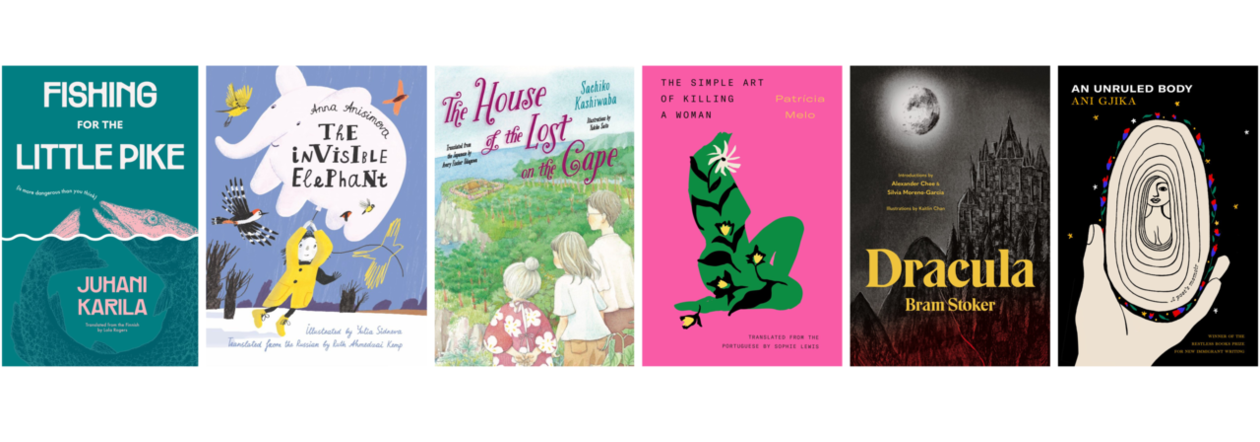
And please stay tuned for news of our 2021 New Immigrant Writing Prize–winning memoir, An Unruled Body by Ani Gjika, whose book is exactly two months away from its publication day! Preorder a copy now, and be sure to check out all the past prizewinners on our website!


by Bothayna Al-Essa
Translated from the Arabic by Ranya Abdelrahman and Sawad Hussain
Finalist, National Book Award for Translated Literature
One of Time Magazine’s 100 Must-Read Books of 2024
Longlisted, 2025 National Translation Award in Prose
A perilous and fantastical satire of banned books, secret archives, and the looming eye of an all-powerful government.
Paperback ISBN: 9781632063342
Publication date: Apr 30, 2024